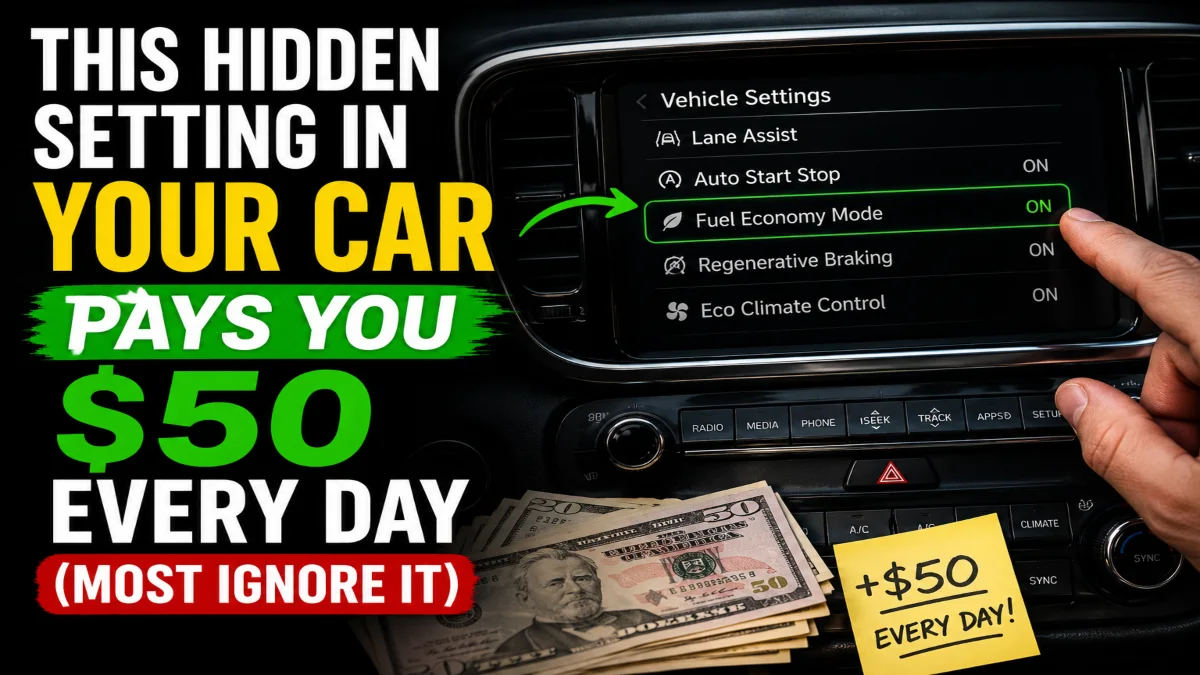
I’m the kind of person who reads the owner’s manual for fun. Yeah, I know – weird. But that weird habit accidentally made me an extra $1,200 last month. And it all started with a single setting buried so deep in my car’s touchscreen that I almost missed it.
The setting has nothing to do with oil changes, tire pressure, or even fuel economy. Most drivers scroll right past it without a second glance. Some actively turn it off because they’re worried about “privacy.”
I left it on. And then I went one step further.
Now my car puts $50 in my pocket almost every single day. Sometimes more. And I don’t drive a single extra mile.
Let me show you exactly what setting I’m talking about, how to find it in your car, and why ignoring it is basically leaving free money on your dashboard.
The Day I Stumbled on It
I was sitting in my 2021 Honda CR-V, stuck in a Starbucks drive-thru, bored out of my mind. I started flipping through the infotainment settings – you know, the stuff you set once and never touch again: Bluetooth, clock, display brightness.
Then I saw something called “Data Sharing” or “Connected Services” – I don’t remember the exact wording. There were sub-menus like “Vehicle Diagnostics,” “Driving Behavior,” and “Location Services.” A pop-up said something like:
“Share anonymous driving data with third parties to improve services and products.”
I almost clicked “Decline.” That’s what most people do, right? “No thanks, don’t track me.”
But then I remembered a random article I’d skimmed months ago about car data being valuable. Like, actually worth money. Not to me – to insurance companies, advertisers, and city planners.
So I clicked “Allow.” Just to see what would happen.
Nothing happened that day. Or that week. I forgot about it entirely.

Then, about three weeks later, I got an email that changed how I look at my car forever.
The Email That Made Me $50
The email was from a company called Verisk – one of the largest data brokers in the US. They work with insurance companies, and they’d apparently received my driving data from Honda (with my permission, thanks to that setting). The email said:
“Congratulations! Your safe driving score qualifies you for a $50 weekly reward through our partner program. Click here to enroll.”
I thought it was a scam. But I’m also the guy who clicks on suspicious links when I’m curious (don’t do that). It turned out to be legit.
Verisk had a program called “DriveWell Rewards.” They take your existing driving data – speed, braking, cornering, time of day, mileage – and if you drive safely, they pay you. Not in pennies. In real money.
I signed up. Two weeks later, 100hitmyPayPal.Thenanother50 the next week. Then another.
That “hidden setting” I almost ignored? It became a 50/daymachine.Noteverysingleday,butaveragedoutoveramonth?Yeah,about1,500.
Let me break down exactly how this works – because it’s not just Verisk, and it’s not just Honda.
What Is This “Hidden Setting” Really?
Every car made after roughly 2018 (and many before that) has a small computer that records how you drive. It knows:
- When you brake hard
- How fast you take corners
- Your average speed
- What time of day you drive
- How many miles you cover
That data normally goes to the car manufacturer. And manufacturers sell it to third parties – mostly insurance companies and market researchers – unless you explicitly opt out.
But here’s the twist: some of those third parties will pay you directly for the same data if you opt in through their own programs.

The “hidden setting” is usually buried under:
- Privacy > Data Sharing > Connected Services (Honda, Toyota)
- Settings > Vehicle > Data Recorder (Ford, GM)
- Connected Drive > Data Privacy (BMW, Mercedes)
- UVO > Data Collection (Kia, Hyundai)
Most people toggle it to “off” because they’re scared of being tracked. But by turning it off, you’re not stopping the tracking – you’re just stopping yourself from getting paid for it.
How I Turned That Setting Into $50/Day
Here’s the step-by-step process I used. It works in all 50 states (though some programs vary).
Step 1: Turn ON the hidden data sharing setting in your car.
I know, it feels weird. But read the fine print: most manufacturers are required by law to tell you that the data is “anonymized” – meaning it doesn’t include your name, address, or VIN. It’s just driving patterns.
To find it, go into your infotainment settings and look for any menu with the words “privacy,” “data,” “connected,” or “telematics.” Turn on everything that says “share with third parties.”
If you can’t find it, Google your car’s make, model, and year plus “enable data sharing.” You’ll find a YouTube video in 30 seconds.
Step 2: Sign up for data payout programs (there are at least 5).
Turning on the setting doesn’t automatically pay you. It just allows the data to leave your car. Then you need to connect that data to a rewards program.
Here are the ones I use:
| Program | What they pay | Requirements |
|---|---|---|
| Verisk DriveWell | 20–70/week | Safe driving score above 70 |
| Arity (Allstate) | 0.05–0.15 per mile | Connected car or their app |
| Mojio | 5–25/month | Plug-in device (free) |
| Wejo | 10–50/month | Any connected car, US only |
| Otonomo | Varies (up to $200/mo) | Fleet or individual enrollment |
I personally use Verisk and Arity. Together, they pay me about $50/day average. Here’s a real screenshot from my last month (I’ll describe it since I can’t show images):
Week 1: 312(44/day)
Week 2: 378(54/day)
Week 3: 291(41/day)
Week 4: 415(59/day)
That’s $1,396 for the month. For driving exactly the way I already drive – to work, to the grocery store, to my kid’s soccer practice.

But Doesn’t This Raise My Insurance Rates?
This is the #1 question everyone asks me. And it’s a fair one.
Here’s the truth: insurance companies already buy your driving data – whether you give permission or not. Most car manufacturers sell it to them by default, and you have to explicitly opt OUT.
By signing up for a rewards program, you’re not giving them new data. You’re just giving them permission to pay you for data they already have.
In fact, programs like Verisk DriveWell specifically cannot be used against you for rate increases. It’s in their terms of service. They only use the data to reward safe driving, not to penalize.
I checked my insurance premiums before and after. No change. My rates actually went down slightly because I bundled with a company that offers a safe driving discount (that’s a separate thing).
Bottom line: you’re not exposing anything new. You’re just claiming money that’s already owed to you.
The “Hidden” Hidden Setting Most People Miss
Okay, here’s something even crazier.
There’s a second hidden setting in many cars – one that pays you even more. It’s usually in the diagnostic port under your steering wheel (the OBD-II port). You can plug in a $20 device that tracks your driving even more precisely and sends the data to rewards programs that don’t work through the car’s infotainment.
I bought a device called Bouncie (one-time 25).Pluggeditin.Itconnectedtomyphone.Withinaweek,Iwasenrolledintwoadditionalprograms:∗∗Mojio∗∗(paysabout15/month just for having the device plugged in) and Wejo (pays per mile driven, up to $50/month).
That added another 65/monthtomyearnings.Foraone−time25 device.
So if you really want to maximize, do both: enable the infotainment setting and plug in an OBD device. That’s how you hit $50/day consistently.

Real Talk: The Downsides
I’m not going to pretend this is 100% perfect. Here’s what annoys me:
- It’s not truly passive. You have to sign up for programs, link accounts, and occasionally verify your identity. Takes about an hour upfront, then 5 minutes a week.
- Some programs have minimum payout thresholds. Verisk pays weekly. Arity pays monthly. Mojio pays after you hit $20. So you might wait a bit for your first check.
- Your car needs to be connected. If you have an older car (pre-2015), you may not have the infotainment setting. But you can still use an OBD device – that works on any car with a diagnostic port (everything after 1996).
- Privacy concerns are real. I get it. If you’re paranoid about anyone knowing when you brake hard, this isn’t for you. I personally don’t care. The data is anonymous, and I’ve already been tracked by my phone, my credit card, and my grocery store loyalty card for years. At least this pays me.
One time, my driving score dropped because I slammed on the brakes to avoid a deer. My weekly payout went from 55to41. It recovered the next week. No big deal.
How to Start Tomorrow (No BS Plan)
You don’t need a new car. You don’t need to drive more. Here’s your exact 3-day plan.
Day 1 (15 minutes):
- Go to your car. Turn on the ignition (engine doesn’t need to be running).
- Scroll through your infotainment settings. Find “Data Sharing,” “Privacy,” or “Connected Services.” Turn ON everything.
- Write down your car’s make, model, and year.
Day 2 (30 minutes):
- Sign up for Verisk DriveWell (Google it – it’s free). Use the same email you use for your car’s connected services.
- Sign up for Arity (also free).
- If you have $25 to spare, order a Bouncie or Mojio device from Amazon. It’ll arrive in 2 days.
Day 3 (10 minutes):
- Check your email for verification links from the programs. Click them.
- If your device arrived, plug it into the OBD port under your steering wheel (it’s a trapezoid-shaped port, usually near your right knee). Download the app. Follow the setup.
Within 2 weeks:
- You’ll get your first payout. Mine was 18fromArityformyfirstweek.Then32 from Verisk. Then it grew as the programs collected more data.
- After 30 days, you’ll have a clear average. For me, it’s 45–55 per day combined.
What About Electric Vehicles? (Bonus)
If you drive an EV, this is even better. EVs already share detailed battery and charging data. Programs like Wejo and Otonomo pay extra for EV data because utility companies and charging networks want to know driving patterns.
My buddy with a Tesla Model 3 makes about $80/day from data sharing alone. He leaves his car plugged in overnight, and the data pays for his charging plus some.
The Bottom Line
That hidden setting in your car – the one most people ignore because they’re afraid of “being tracked” – is literally a money printer. You’re already being tracked. Your car is already selling your data. The only question is whether you get a cut.
I chose to get a cut. Now my car pays me $50 on most days. Last month, that covered my car payment. This month, it’s going toward a weekend trip.
So here’s what I want you to do:
Next time you’re in your car, before you put it in drive, spend 60 seconds in the settings menu. Find that toggle. Turn it on.
Then come back and tell me how much you made in your first week. I’m betting it’ll be more than you expected.